
There are many terms on a payslip, and it's completely natural to feel a little unsure about what it all actually means. Here's a step-by-step explanation that will hopefully answer any questions you may have about your payslip. Remember, too, that your payslip is interactive in Zenegy's employee app, where you can tap terms and read a short explanation.
Step-by-step guide to your payslip:
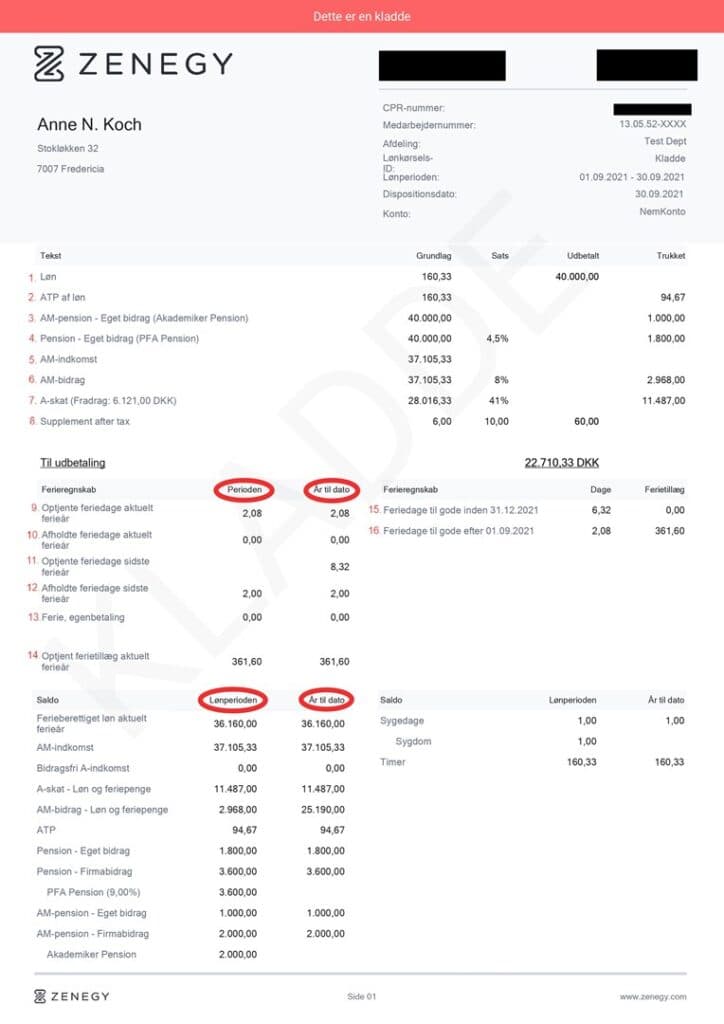
- Here you can see how many hours you've worked this month (here: 160.33 hours) and what you're paid (here DKK 40,000)
- ATP is short for Arbejdsmarkedets Tillægspension (the Labour Market Supplementary Pension). ATP is a statutory pension savings scheme and an extra supplement to the state pension. For full-time employees, the employer pays ⅔ of the ATP contribution and the employee pays ⅓ of the total amount every month
- Here you can see AM pension, own contribution. This is a fixed amount.
- Here you can see which pension provider you pay into and how much
- Here you can see the amount your labour market contribution (AM-bidrag) is calculated from
- AM-bidrag stands for arbejdsmarkedsbidrag, the labour market contribution. It's a tax of 8 per cent that is deducted from your pay. You as the employee pay it, and it is statutory
- Here you can see your personal allowance per month, your tax rate and finally how much you pay in tax
- Here you can see your approved supplements and deductions since the last pay run. Here you'll find, for example: reimbursement of out-of-pocket expenses, or deductions for the staff association and lunch scheme
- Here you can see how many days of holiday you've earned in the current holiday year. The current holiday year started on 1 September 2021. The period shows what you've accrued since the last pay run, and year to date shows the total accrued for the year
- This shows how many days of holiday you've taken in the current holiday year. The period shows how many days of holiday you've taken since the last pay run, and year to date shows how many days of holiday you've taken in the year
- Here you can see how many days of holiday you accrued in the last holiday year. The last holiday year's accrual period runs from 1 September 2020 to 31 August 2021
- This shows how many days of holiday you took in the last holiday year. The line is only shown if you've used holiday from the last holiday year since the last pay run
- Here you can see how many days of holiday you've registered as “holiday at your own expense. Holiday at your own expense is holiday the company doesn't pay for. This is if you've either taken more days than you had available, or if you choose to use holiday accrued with a previous employer
- Here you can see how much holiday allowance you've accrued in the current holiday year. The period shows what you've accrued in this pay run, and year to date shows the total accrued for the year
- Here you can see how many days of holiday you need to use before 31 December 2021. These are days of holiday you accrued in the old holiday year (from 1 September 2020 to 31 August 2021). Remember that you can only transfer 5 days of holiday, and that this must be agreed with your employer
- Here you can see how many days of holiday you have left in the current holiday year (from 1 September 2021)
About the payslip in general:
Circled in red on this payslip, you can see two terms: Period and Year to date. Period means the period since your last payslip – that is, the changes there have been since your last pay run. A change could be, for example, that you've taken holiday. Year to date means the total balance to date for the holiday accrual year.
SH and the free choice scheme
SH scheme:
SH only applies to hourly paid employees, so you'll only see SH on your payslip if you're paid by the hour. SH stands for søgnehelligdag: public holidays that fall on a weekday. The SH scheme is for hourly paid employees who would otherwise have worked on these public holidays but now miss out on the pay they would have earned. Many collective agreements have therefore introduced an SH scheme, which means the employer must cover the lost pay with an SH payment.
Free choice scheme:
The free choice scheme is a collective agreement scheme. If the company is part of a collective agreement, a percentage of the employee’s holiday-entitled salary must be deposited into a discretionary savings account. The free choice scheme gives employees the free choice to decide how part of their salary should be used. As a starting point, the employee can decide whether the free choice scheme is to be used for an extra salary payment, to cover e.g. holidays, public holidays etc. But the employee can also decide to use the optional scheme for additional pension savings.
Read more about SH and free choice and see how to set this up in Zenegy .